

“An education capable of saving humanity is no small undertaking; it involves the spiritual development of man, the enhancing of his value as an individual, and the preparation of the young to understand the times in which they live.” ~ Dr. Maria Montessori
What does bullying behavior look like in a Montessori classroom? Not always what you might expect. Lucas was quiet, cooperative, and bright — a child who had spent three contented years in the Children’s House Classroom, learned to read at four, and moved through the math curriculum with capable confidence. He had good friends. He seemed happy. There was nothing, at first glance, that would have given his teachers any cause for concern. There rarely is.
During Lucas’s first year in the Lower Elementary classroom, his mother and father announced they were getting a divorce. It was a messy and very public event that affected Lucas and his brother deeply.
By the following year, Lucas’s deportment changed. He remained focused and engaged with his work, but his demeanor was markedly different. He was still quiet but now seemed sullen and angry. He had stopped playing with the friends he made in Children’s House and was spending more time with younger students — particularly a young girl named Mara.
Lucas’s teacher, Nancy, saw the relationship between Lucas and Mara as sweet. Both children were quiet, and they appeared to enjoy each other’s company. They played together during recess and occasionally worked with one another during the morning work cycle.
In November of that year, Mara’s mother, Beth, called Nancy. She said she had serious concerns and needed to meet with Nancy about Mara’s friendship with Lucas. She ended the call by saying that Mara would not be returning to school until they had sorted things out. Nancy was taken aback. Beth had always been warm and supportive, and this response — whatever had prompted it — was a huge departure from her usual manner.
Beth and her husband met with Nancy the next day. After a brief exchange of pleasantries, Beth began to cry. She told Nancy that Mara had been having trouble sleeping. “The other night,” she said, “Mara woke up screaming. I ran into her room and held her. When I asked what had happened, she wouldn’t speak. I wound up holding her for an hour before she finally started talking. Mara told me that Lucas had been hurting her at school — forcing her to play with him and threatening to hurt her more if she played with anyone else. Apparently, he hurt her badly one day when they were outside, and when she tried to go find a teacher on the playground, Lucas told her he would kill her mother — that’s me — if she said anything.”
Nancy didn’t know how to respond. She trusted Beth. Beth never complained and was always even-tempered and rational. Privately, Nancy was horrified — and ashamed. How had she not seen this? Lucas and Mara were together a lot, but Mara had never appeared to be in distress. How had she allowed something like this to happen to a child in her classroom?
Nancy knew she needed support. She let Beth and her husband know that she would speak with her head of school and would call them back to schedule a follow-up meeting with everyone present. Beth let her know that they would be keeping Mara out of school until there was a plan in place. Nancy said she understood and reassured her that they would get to the bottom of what had happened and ensure that Mara was safe. The hard truth, though, was that she had no idea yet how to do that.
Is It Really Bullying? Why Getting the Definition Right Matters
Formal anti-bullying programs began making their way in the late 1980s. By the late 1990s and early 2000s, the anti-bullying movement had gained significant momentum as a social movement, propelled by national media coverage, expanded research, widespread adoption of anti-bullying programs, and the introduction of anti-bullying legislation.
For those of us who were teaching in the late 90’s and early 2000s, we witnessed both the positive and negative effects of this important social movement. Positively, bullying was finally being taken seriously, rather than dismissed as a natural part of growing up. We now know with certainty that bullying can be not only hurtful but psychologically damaging, with effects that can extend well into adulthood (Wolke & Lereya, 2015). Negatively, we watched the term “bullying” expand to include a wide range of typical childhood misbehaviors that, while hurtful at times, were not actually bullying. This broadening blurred the boundaries between bullying, peer conflict, and social aggression.
The consequences of this blurring were significant — and cut in two directions. First, serious interventions designed to protect children in genuine bullying situations — zero-tolerance policies, removal from the community, punitive and aggressive disciplinary action — began to be widely applied to developmentally normal misbehaviors. Children lost critical opportunities to learn conflict resolution, navigate difficult social dynamics, and build problem-solving skills and resilience. Second, and equally important, when bullying is too broadly defined, the specific and defining features of a true bullying dynamic are more likely to go unnoticed. The targeted, intentional interventions needed to effectively address bullying may be diluted, allowing the harm to quietly continue. Over time, teachers — particularly in response to frequent parent accusations of bullying — can become desensitized to the term altogether, and when a real bullying situation arises, it may not receive the serious attention it deserves.
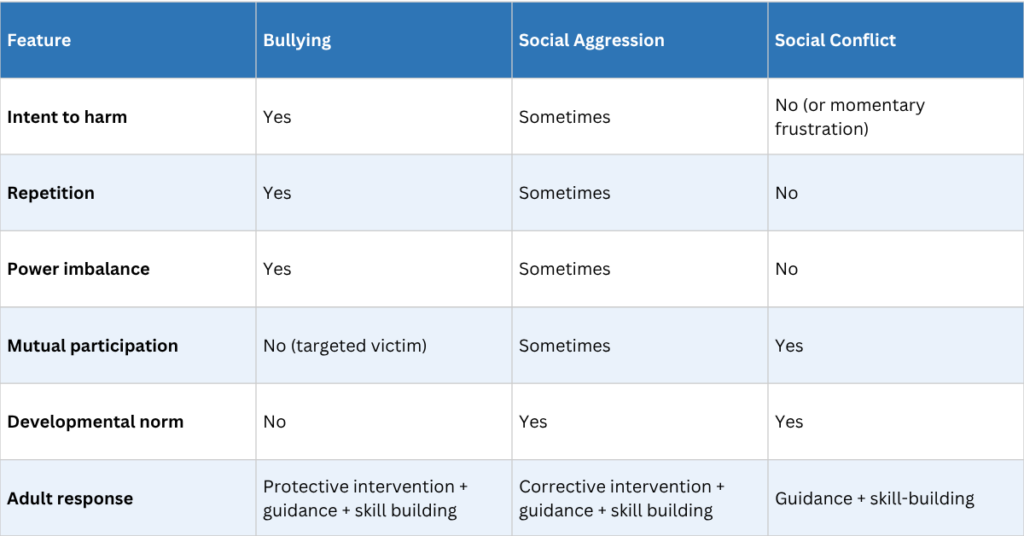
One of the most important distinctions between bullying, social aggression, and social conflict lies in how adults should respond. In a bullying situation, adults need to take appropriate control to provide physical and psychological safety for the child being bullied. Problem-solving and repair that includes the participation of the community comes second. In situations involving social conflict or social aggression, adults do not take control, but provide intentional and scaffolded support as children work through the problem-solving and repair process.
Bullying
Let’s start with the most serious one. Using the understanding gained by researcher Dan Olweus , developmental scholars define bullying by three specific criteria that must all be present to fit the definition (Olweus, 1993):
- Intent – The behavior is proactive and intentional, not reactive or accidental. The harm may be physical, social, or psychological.
- Repetition – The behavior is not situational or a one-time incident. It is repeated over time, sometimes over a long period.
- Power imbalance – The child exhibiting the bullying behavior has real or perceived power over the child being bullied. Bullying is typically directed at a specific child — and sometimes a small group — over time, creating a pattern of harm reinforced by that power imbalance. The child being harmed has difficulty defending themselves and often feels powerless.
Bullying can manifest directly, with one child targeting another, as with Lucas in the opening of this article. It can also manifest collectively, where the child doing the bullying involves peers. Direct bullying might include physical aggression, verbal threats, isolation, and teasing. Social or relational bullying might involve deliberate exclusion, gossip, and manipulating friendships. But it’s not just the behaviors that make bullying what it is. What makes it unique is how these hurtful behaviors occur: targeting one child, over time, and using a power imbalance to cause harm.
When more than one child is participating in the bullying, it may appear that a group is targeting the child. However, in nearly every case of actual bullying — where all three criteria are present — there will be a ringleader who is initiating and directing the effort to harm the target. Identifying that ringleader is critical to intervening effectively.
Social Aggression
Social aggression (see article on teasing) can look a lot like bullying because it can be hurtful and intentional. And, it should be taken seriously. However, social aggression — while sometimes proactive or calculated — is not always repetitive and may or may not involve a power imbalance.
Consider this situation: one day, a friend group in a Lower Elementary classroom intentionally excludes one of their friends from a game at recess. They had planned the exclusion earlier in the day, and when the child asked to play, they told him only “expert players” were allowed. He was deeply hurt. In this group, though, the role of the excluded child tended to rotate from day to day — he might well be doing the excluding tomorrow. Upon hearing their son’s heartbreak, his parents contacted the school, worried he was being bullied.
Were they right to be concerned? Absolutely. Was the behavior hurtful? Yes. Was it bullying? No — and that distinction matters. Because the situation lacked the defining features of bullying — specifically, repetition directed at the same child and a stable power imbalance — it calls for a different kind of adult response: not adult control, but direct support that helps children develop the empathy, resilience, and conflict-resolution skills they need to navigate friendships well.
Social Conflict
Social conflict (see article on social conflict) is probably the most frequently misidentified as bullying — especially by concerned parents. It is part of daily life in a Montessori classroom, yet it may not meet any of the three criteria for bullying. There is generally no real intent to cause lasting harm, and hurtful behavior is often reactive rather than premeditated. Any power imbalance that exists tends to be incidental rather than a defining feature of the conflict. And while a pattern of conflict may develop — the hot-and-cold dynamic familiar to many classrooms — the conflict itself is situational and temporary, with both children typically participating on equal footing.
Social conflicts are developmentally typical. They are also developmentally necessary. Learning how to have difficult conversations, how to navigate social dynamics, arguments, and fallings-out are some of childhood’s most important lessons. While uncomfortable, these experiences help build resilience, empathy, forgiveness, assertiveness, and relationship skills.
Why the Distinction is So Important
The distinction between bullying, social aggression, and social conflict matters because the behavior determines the intervention. If social aggression or social conflict are treated as bullying, adults may over-control the situation, assign motivations where they don’t belong, and remove agency from the children involved. Children may not only miss an opportunity to learn critical social and life skills — they may also be harmed socially and emotionally. If bullying is misidentified as social aggression or social conflict, and adults presume equal power between the children, they may respond with too light a touch, perhaps by facilitating conflict-resolution between the two children — which can expose the target of bullying to further harm (Menesini & Salmivalli, 2017). Bullying prevention is effective when adults accurately define the features of bullying and align effective and appropriate responses (Gafney et al., 2019).
In a Montessori environment, this understanding supports our concept of the prepared adult. We are not to micro-manage every conflict, nor to abandon a child to the cruelty of another. Our goal is to carefully observe and prepare the social environment in a way that supports the needs of the child, the community, and the situation.
Roles in a Bullying Dynamic
While a bullying dynamic centers on the child who bullies and the child who is targeted, it is never really about just two children — it involves the whole classroom community (Salmivalli et al., 1996). Even when it occurs between two children, it is often sustained – actively or passively – by others in the environment.
Consider Lucas and Mara. The bullying was direct and did not involve other children on the surface, yet it was quietly supported by the community around them. Other children witnessed what was happening and neither stepped in nor alerted an adult — many feared becoming targets themselves (Salmivalli, 2010). Mara had one close friend she confided in, and while that friend confronted Lucas a few times, she was ultimately too intimidated to act further or tell an adult. So while no one intended to support the bullying, they did. Lucas learned, without anyone saying a word, that his behavior would go unchallenged.
This is how a bullying dynamic sustains itself — not only through the actions of the child who bullies, but through the silence and uncertainty of everyone watching (Salmivalli et al., 1996).
The Child Who Bullies
The child who bullies initiates and leads the hurtful behavior. While the harm may appear to happen between only two children, it is always sustained by those who passively observe (Salmivalli et al., 1996). A child who bullies may also recruit others, acting as a ringleader — though their influence may be subtle or obscured by the group dynamic.
Adult intervention must directly and firmly address the behavior. At the same time, it is important to remember Dreikurs’s principle: a misbehaving child is a discouraged child. A child who bullies is operating from a mistaken belief about how to find belonging and significance in their community. Bullying is a behavior, not an identity. Supporting this child means stopping the behavior directly while helping them find constructive paths to belonging and significance in their community.
There is a strong connection between adverse childhood experiences and bullying behavior — Lucas is a good example (Cook et al., 2010). This doesn’t excuse the behavior, but it does remind us that the child who is bullying may be a child in pain. An effective response — kind and firm at the same time — addresses both the behavior and what is driving it.
The Child Being Targeted
The child being tagged is on the receiving end of repeated, intentional harm. They hold less power in the relationship — and it does not matter whether that lack of power is real or perceived (Olweus, 1993). A child’s experience of powerlessness is their reality. Knowing that others are following or silently permitting the bullying only deepens that experience. Over time, targets are likely to feel unsafe, ashamed, and cut off from the community (Olweus, 1993).
Being targeted is also not an identity — which is why, throughout this article, the child being bullied is referred to as the child being targeted, not the target. Supporting this child means providing protection, restoring their sense of belonging, and building skills — including assertiveness and help-seeking — that support their confidence and safety going forward.
Followers
Followers may actively participate in bullying behavior, or they may reinforce it from the sidelines through laughter, encouragement, and positive attention directed at the child who bullies (Salmivalli et al., 1996). Either way, their support rewards the behavior and helps sustain it. Research suggests that children in this role often participate out of fear — specifically, fear of becoming the next target (Salmivalli, 2010). Supporting a child in this role means helping them recognize how their behavior sustains the dynamic and building the skills to withdraw their attention and approval and resist negative peer pressure.
Bystanders
Bystanders are passive, yet consequential, participants in a bullying dynamic. Bystanders may privately disapprove of what they’re seeing, but their silence functions as permission (Salmivalli et al., 1996). They may want to act but feel they lack the skills or the social standing to do so. Like followers, bystanders are often afraid of becoming targets themselves (Salmivalli, 2010). Supporting a bystander means giving them the skills and confidence to seek help or intervene — to move from passive witness to active defender.
Defenders
Defenders actively support the target. They may intervene directly, offer comfort, or seek adult help. Even one defender can significantly disrupt a bullying dynamic (Salmivalli et al., 1996) — which makes adult recognition of this role essential. When adults dismiss a defender’s report as tattling, they risk disempowering the very child who is trying to help, while inadvertently signaling to the child who bullies that the behavior will be tolerated. Supporting the defender means encouraging and affirming their behavior, and empowering them to serve as a model for bystanders and followers — a key to shifting the group norm away from tolerance and toward accountability.
Can Adults Take on Roles in a Bullying Dynamic?
Yes — absolutely. Adults can unintentionally take on any of the roles described above. I have witnessed adults who subtly engage in bullying behavior themselves. In other cases, adults become bystanders or impotent defenders when they fail to recognize the dynamic — particularly when an older student is well-liked and has enlisted followers. Adults can even become targets. In one case at our school, an upper elementary student who had gained social influence among her friend group began quietly directing that group to bully their teacher — refusing to communicate, withdrawing from activities, mocking her, and gradually recruiting others to do the same. It was a serious dynamic that required immediate intervention.
Can a Child Take on More Than One Role?
Yes. Researchers have identified a group of children who occupy two roles simultaneously: children who are being targeted by a bullying child and then target someone else who has less social capital than themselves. In a Montessori classroom, this dual role can be particularly difficult to identify, because the child may participate in the bullying dynamic in two different ways in the same day. Children who play this dual role are also particularly vulnerable to long-term psychological harm and benefit from differentiated support that addresses both their experience as a target and the harm they are causing others. (Olweus, 1993; Schwartz, 2000)
Bullying Behavior and the Montessori Planes of Development
Toddler (0–3 years) – In a toddler classroom, true bullying does not yet exist. While toddlers can be physically or verbally aggressive — even repeatedly so — they do not yet have the ability to understand and exploit a power imbalance (Tremblay, 2000). Their aggression is instrumental: they hit, bite, or push to get something they want, avoid something they don’t want, or communicate something they can’t yet put into words. Any harm to another child is typically incidental rather than intentional in any meaningful sense. What may look like bullying at this age is generally the result of communication and self-regulation skills that haven’t yet developed. Key interventions include direct teaching of social and communication skills, redirection, distraction, and proactive support and supervision.
Children’s House (3–6 years) – In the second half of the first plane of development, children begin to engage in hurtful behavior that has a social motive. Social aggression — often confused with bullying — may be observed as children approach 4–5 years of age (Crick & Grotpeter, 1995). It can manifest as exclusion (“You can’t come to my birthday party”) or using friendship as a threat (“You can’t play with us unless you are the bad guy”). However, hurtful behavior at this age is still typically incidental rather than premeditated — triggered by a social threat, a situational reaction, or dysregulation. If a power imbalance exists, it is most likely situational rather than established and sustained. That said, while true bullying is rare in a Children’s House classroom, a 6-year-old emerging into the second plane may have developed enough social, cognitive, and communication sophistication to engage in it — though what you’re seeing is still most likely social aggression, a precursor to bullying. Key interventions include heightened supervision, direct teaching of social and relationship skills, support for conflict resolution, and community building.
Elementary (6–12 years) – It is in the second plane of development that true bullying begins to emerge (Olweus, 1993). Children now have the cognitive and social development to enact premeditated harm. As the elementary child enters the sensitive period for socialization, the peer group becomes a primary social influence. Hurtful behavior becomes more deliberate as children develop a greater awareness of social hierarchies within the classroom community and a deepening understanding of cause and effect. All three elements of bullying — intentionality, repetition, and power imbalance — can now present themselves. The developmental need to belong can become weaponized by a bullying child. Bullying behavior may include social isolation, exclusion, physical aggression and threatening, gossip, teasing, and mocking. Key interventions include direct protective adult intervention, direct support for the child being bullied, social and relationship skill building, classroom community awareness of dynamics, and a whole-community approach to repair and prevention.
Adolescence (12–18 years) – Students in the third plane of development are at heightened risk for participating in or being the target of bullying (Espelage & Swearer, 2003). While bullying can take place throughout the third plane, it is most common in early adolescence, when students are most sensitive to belonging among their peers and social hierarchies become most deliberate — a quest to achieve or maintain social status. Environments where popularity dynamics run strong are fertile breeding grounds for bullying.
Adolescent bullying is likely to include physical domination, gossip, exclusion, social isolation, cyberbullying, mockery, and attacks on identity. Because adolescents are in a sensitive period for identity formation, identity becomes a prime target for the power imbalance particular to bullying — attacks on family background, ethnicity, sexuality, or other identity dimensions are common and can cause long-term harm.
Another dynamic that can add fuel to the fire is the adolescent’s natural drive toward autonomy from adults, colliding with an intense craving for peer belonging. An adolescent who is being bullied is much less likely to confide in an adult — and those around them much less likely to report it — out of fear of further isolation and exclusion from their peers. Key interventions include direct protective adult intervention that is sensitive to the adolescent’s need for autonomy, direct support for the child being bullied, peer support, social and relationship skill building, classroom community awareness of dynamics, and a whole-community approach to repair and prevention.
Preparing the Montessori Social Environment to Prevent and Address Bullying
- Regular Class Meetings – Regular Class Meetings are an essential component in preventing and responding to bullying (Olweus & Limber, 2010). Direct teaching of social skills that prepare children to recognize and respond to bullying is not a once-a-year event. The consistent practice of problem-solving in Class Meetings prepares the community to address more serious problems — like bullying — when they come up. These meetings prepare not only the students but the teachers in the art of group problem-solving. Some teachers resist the idea of holding Class Meetings three to four times per week in an elementary or adolescent environment (daily in a Children’s House environment) and then find the community unprepared to resolve something as serious as bullying when it crops up. Everyday problems about lost pencils, unfairness during a recess game, or classroom jobs not being done give students ownership and agency in the goings-on of the classroom. When children see that their voice makes a real difference, they are more likely to step in to prevent bullying — and more likely to participate in solving the problem if it does appear. Research has shown that non-hierarchical classrooms where power is evenly distributed, prevent bullying from flourishing (Garandeau, Lee & Salmivalli, 2014). Without consistent practice, the skills, experience, and trust needed to work through a serious problem effectively simply won’t be there. I have said this many times to groups over the years: I have dealt with bullying situations throughout my career, and I have no idea how schools actually unravel a bullying dynamic without the Class Meeting structure already in place. Adults cannot do it alone. The community needs to be part of the solution.
- Parent Education – Proactive parent education on the bullying dynamic can help nip a problem in the bud. Research consistently identifies parent involvement as a key prevention strategy (Gaffney et al., 2019) — and it may also determine whether you receive support or pressure when a real situation arises. Consider a brief presentation at a parent evening that covers the sensitive period of development for your students, the differences between social conflict, social aggression, and bullying — what each one is, and what it isn’t — warning signs to watch for at home, and what to do if they suspect something is happening. Enlist parents as partners before a situation arises, not after.
- Social Observation – As you observe the students in your classroom, be on the lookout for changes in behavior, particularly among students who do not hold much social capital. Signs from a child who is being targeted may include withdrawal, a sudden change in friendships, staying near adults, loss of belongings, minor unexplained injuries, or changes in appetite and sleep (parents may report nightmares) (Olweus, 1993). Children who are bullying tend to have more social capital in the classroom; they may be controlling or “bossy,” isolate the target from their typical friend group, respond with deference to adults while becoming quietly aggressive toward their target, and may also enlist supporters (Salmivalli et al., 1996).Bullying behavior can take place during any part of the day. However, there are three times when it is most likely to occur: lunchtime, recess, and transitions. These settings share key conditions — longer stretches of less structured time, free socialization, and reduced adult involvement — that create opportunity (Olweus, 1993). Lunchtime and recess also sit right in the middle of the day, when teachers and children are starting to tire and move into higher-energy, lower-structure settings with fewer adults and reduced supervision. Suggestions for each setting follow.
- Lunch– Lunch is a time with little structure and often longer periods of waiting — after finishing eating, cleaning up, and waiting to be dismissed for the next activity. Choosing where to sit is itself a situation ripe for exclusion and social power dynamics. Consider having the teacher who supervises lunch take their break beforehand, so they arrive at lunch with some breathing room for a setting that requires more intentional supervision. Also consider family-style seating — everyone at one long table. Work with children in Class Meeting to generate ideas that prevent students from being excluded at lunch. Reading aloud or playing an audiobook during lunch can shift the social temperature of the room considerably. Involve students in creating a cleanup routine that maximizes efficiency, safety, and collaboration.
- Transitions – The key to safe and effective transitions is taking time to plan — first with adults to establish the overall structure, then with children to work out the details. Well-planned transitions (see Transitions article) ensure adult presence, allow time for practice, and leave little room for bullying or social aggression.
- Recess – Adult engagement at recess is not optional. Unstructured free play is important; and too much unstructured free play creates conditions where bullying can quietly take hold (Olweus, 1993). Rather than hiring a floater to cover elementary and adolescent students during recess, consider in a physical education teacher to run voluntary activities. Ensure there are enough outdoor activities and playground elements, especially for older children. If older students don’t have structured options, they will create their own — and the children with the most social capital will lead them, assign roles, and set the terms. Active supervision with proximity is essential with elementary and adolescent students as well as younger students. Too often, teachers supervise from the periphery with visual-only awareness. If you’re watching with your eyes, you’re doing about half the job. You need to supervise with your ears as well — listening to what children are saying, how they’re speaking to one another, and what games they’re playing.
- Bullying Identification – When you observe hurtful behavior, look for the defining features: intention, repetition, and power imbalance (Olweus, 1993). Work with colleagues to identify what you’re seeing together. Is it true bullying? Social aggression? Or conflict? Remember, social aggression can be the gateway to a true bullying dynamic. Being proactive is the best medicine.
- Bullying Response Plan – Don’t wait until bullying happens to make a plan. The plan doesn’t have to be complicated, but it should cover immediate adult interventions (separation of children, notifying parents, close supervision), direct support for the target (validation, involvement, community support, participation in resolution), and support for the child doing the bullying (validation, repair, participating in resolution, finding constructive paths to belonging).
- Handbook Policies and Procedures – Define bullying, social aggression, and social conflict in your school handbook, and provide a general description of how your school will respond. Avoid being overly general — parents want to know that serious situations will be handled — but also avoid being overly specific, as you want your plan to serve as a guide that allows for professional judgment based on the situation and the children involved. Your policies should be firm enough to communicate seriousness and flexible enough to allow for the kind of thoughtful, individualized response that Montessori communities do well. Regarding cyberbullying: consider including language in both parent and staff handbooks clarifying that online behavior that affects the school or classroom community falls within the school’s jurisdiction and will be addressed accordingly. Because legal authority over off-campus online behavior varies by state and jurisdiction, schools should consult with legal counsel to determine the appropriate scope of their policy language.
- Model Kindness and Firmness at the Same Time – All of Positive Discipline in the Montessori Classroom has as its goal helping adults learn, concretely, how to be kind and firm at the same time with children. Kindness and warmth invite openness, trust, and cooperation. Firmness invites safety, security, and predictability. A kind and firm adult sends the message, “I am on your side. You matter, and I will listen to you.” They also send the message, “I am trustworthy. I will keep you and the community safe. I say what I mean and mean what I say — without being mean.” (Jane Nelsen)
Grace and Courtesy Skills to Prevent and Address Bullying
Prevention is the most effective way to address bullying. The good news for Montessori practitioners is that our pedagogy is already developed around prevention through preparation. Grace and courtesy skills — social skills — are the epitome of prevention through preparation, teaching children what to do rather than what not to do.
- Defining Bullying – Information is power. Elementary children have the capacity to understand the bullying dynamic, and frankly, it often catches them off guard. It can be scary, confusing, and invoke feelings of shame, inadequacy, and shock. Understanding the basics — power imbalance, repetition, and intention — can help end the cycle before it gains traction. With collective understanding, bystanders and defenders are more likely to recognize bullying for what it is and do something about it. Read stories and children’s novels in which bullying takes place. Identify the roles together. Highlight what children do and do not do.
- Assertiveness – Assertiveness is one of the most proactive social skills children can learn. Research generally suggests that children who develop strong assertiveness skills are better equipped to recognize and respond to bullying behavior, though it is worth noting that assertiveness alone is not a guaranteed protection — any child can be targeted, regardless of how socially confident they are. From the time young children enter the Children’s House, take time to teach assertiveness skills: how to say “No,” “Stop,” “I don’t like that,” or “Please walk around my mat.” Simple words, but saying them with kindness and firmness takes practice. Teach them collectively and individually.
- Walking Away – Walking away from disrespect is not the same as running away from a problem. Give children words to say, followed by action: “No thanks, I’ll find something else to do,” followed by walking away from the situation. This is important to practice. Equipping children with words and actions to use in a frightening moment can give them the courage to remove themselves from a bullying attempt. Bullying behavior needs a target to oppress. Taking away the target can break the cycle before it begins.
- Asking for Help – Children who are targeted often — though not always — tend to be more socially isolated or have fewer strong peer connections, which can make them more vulnerable. Identify these children before social aggression or bullying begins. Take time to teach them how to ask for help. For children who tend to withdraw or give up rather than ask, teach them how to approach an adult discreetly, especially if they are worried about social consequences. They can also learn to ask a trusted friend to help them talk to an adult.
- Tattling vs. Reporting – Even in Montessori classrooms, children who tell a teacher about a problem they witness may experience a negative response from their peers — teasing, mocking, or excluding. Take time to talk with children about the difference between tattling and reporting (see Tattling article). What’s the difference? What does each one look like? Reporting is about safety — when someone is being hurt physically or emotionally, or is in danger of being hurt. Tattling is typically about getting the adult to take sides. When bullying is happening, reporting is not just acceptable — it is the right thing to do.
- How to Defend a Friend – This is one of the most wonderful and important skills to teach in the context of bullying. The bullying dynamic depends on the support of community members — whether through active participation or inaction. Without peer support, bullying is likely to stall before it does long-lasting harm. Positive peer action is remarkably effective at stopping a bullying dynamic before it gets out of hand.
- Conflict Resolution – Direct teaching and support of conflict resolution skills builds resilience, communication, and assertiveness. In addition to teaching and practicing with the whole group, identify children who tend to be passive, conflict-avoidant, or have developing social skills. Look for small opportunities — low-stakes ones at first — to support them in working through social difficulties with friends. Be proactive.
- I Language – I Language is part of the formal conflict resolution model in Positive Discipline in the Montessori Classroom, but children don’t need to wait for a formal conflict resolution session to use it. I Language gives children a structure for communicating a problem — building the confidence to set and maintain boundaries effectively while preserving their own dignity.
General Responses for Bullying Behavior
- Physical Separation – Upon identification of a bullying dynamic, the first step is for adults to directly intervene to keep the child being targeted safe. This means separating the two students — and, if followers were involved, separating the ringleader from them as well (Olweus, 1993). Our most important job is to keep everyone safe. Communicate the reason for the separation to both children, separately, kindly and candidly; if you’re angry, wait until you’re not. Remember: there are two discouraged children here, and kindness and firmness matter for both of them. This intervention may feel foreign in a Montessori environment. Separation is not about punishment — it’s about safety, and the long game is repair and community empowerment. If other children supported the bullying dynamic as followers, consider separating the ringleader from the followers as well, until the class has begun the repair and recovery process. Note: While suspension is generally a last resort, in severe situations, a temporary separation from the community may be necessary until the school is confident that reasonable safety can be maintained for the child who was targeted.
- Parent Communication – Notify the parents of the children involved as soon as the dynamic is discovered. These conversations will be difficult. The aim is to share the pattern you’ve observed, what you are currently doing to keep all the children safe, and your plans for repair and recovery. Plan formal follow-up conversations to review progress.
- Parent Partnership with Cyberbullying – Encourage parents and children to document everything possible with screenshots before anything is deleted. Partner closely with parents around device access and usage during the recovery period.
- Adult Supervision – Recovery and repair will be a process. While you are supporting and guiding the community, adult supervision will need to be high (Olweus, 1993). Shadowing the child who was bullying during unstructured times will likely be necessary, and classroom teachers should know where everyone involved in the dynamic is during the day — with particular attention to the child who bullied and the child who was targeted.
- Buddy System – With the child who was targeted, identify a trusted peer to act as a safety buddy. If possible, choose a child who has taken on the role of defender. Make a plan together: the targeted child tells their buddy if they are being hurt. Decide in advance what each will do — does the buddy go tell a teacher, go with the targeted child to tell a teacher, or simply encourage them to talk to a teacher? If possible, enlist more than one child.
- Focus on Solutions and Repair, Not Punishment – Punishment is an alluring trap when addressing bullying behavior. Bullying is intentionally hurtful, so it’s understandable for adults to want to dispense “justice” on behalf of the child who was targeted — and adults may also feel guilty that it happened on their watch. But punishment may stop the behavior temporarily while doing nothing to address its cause (Espelage & Swearer, 2003), repair the harm, or rebuild the community’s sense of safety, trust, and agency. It also robs the community of the opportunity to learn important life skills — because bullying is not relegated to childhood. The goal is to focus on solutions that are reasonable, related, respectful, and helpful for everyone.
- Involve the Bullying Student in the Re-Entry Plan – Whether the child who was bullying is separated within the community or temporarily removed from it, there will need to be a plan for re-entry before recovery can begin. When that time comes, involving them in creating that plan is essential — not optional. A child who is given agency in making the plan is more likely to take ownership of it and follow through.
- Act, Don’t Talk – Lectures and repeated conversations about bullying behavior are not only ineffective — they are likely to make things worse. Talking at the child who bullied, or addressing the whole class in a way that centers them, can inadvertently create an audience and accelerate the development of followers as children seek peer acceptance. Act quickly, clearly, and calmly — kind and firm at the same time — and let your actions communicate that the community is safe. Discussions can follow once safety has been established.
Class Meetings and Recovery from the Bullying Dynamic
The Class Meeting is the most potent tool in our toolbox for recovery and repair from a bullying situation. While there are generally two primary players in the dynamic, the bullying disrupts the safety of the entire classroom. Supporters, defenders, and bystanders likely acted out of fear. Trust needs to be rebuilt. Group dynamics that sustained the harm need to be dismantled. A well-functioning Class Meeting can begin that healing process relatively quickly.
Ideally, all children involved should be present at the Class Meeting when the group addresses the dynamic. It is also important that both the child who was targeted and the child who engaged in the bullying feel ready to participate. This is most likely when the Class Meeting is already part of the classroom culture — when children already have confidence in the process. If it is not yet part of the culture, it may be wise to bring in a school psychologist to support the repair.
In some cases, it may be helpful to hold an initial Class Meeting with only the defenders, bystanders, and supporters — to discuss openly what happened, how each person felt, and brainstorm ideas about how the class can support both children. This can set the stage for a later meeting where the child who was targeted and the child who bullied can participate and receive support from the group.
During the Class Meeting when all members are present, the teacher runs the meeting as they would on any given day — though it may take more than one meeting to work through. The child who was targeted is invited to share what happened; if they don’t yet feel comfortable, a defender can start the conversation. The child who did the bullying is also given a chance to share (in my experience, there are often some surprises here), and then the rest of the students are invited to participate. After discussion, the class brainstorms solutions together — focusing on how to support the child who was targeted, how the child who bullied can find belonging without overpowering others and begin to repair what happened, and what the community can do, both now and going forward, to make things right.
It takes the whole community to sustain a bullying dynamic — even unintentionally. And it takes the whole community to repair the damage and recover together (Salmivalli, 1996). Relationships that have been tested and repaired can emerge stronger than before.
Mistaken Goals and Bullying
“A misbehaving child is a discouraged child.” (Dreikurs, 1964)
When children feel supported and encouraged in the classroom environment — when they know they belong and feel significant through responsibility and contribution — they thrive. With guidance, they develop kindness and respect for others and themselves, and discover how capable they are.
When children feel discouraged, they misbehave, because they have a mistaken belief about how to belong and feel significant. As Rudolph Dreikurs observed children, he identified four mistaken goals that children adopt when they feel discouraged.
While Dreikurs did not write specifically about bullying, the mistaken goals framework offers a genuinely useful lens for understanding what may be driving the behavior — and for shaping a response that addresses the root, not just the surface. Below you will find practical ideas for supporting positive change for each mistaken goal.
Undue Attention (Notice Me – Involve Me Usefully)
Children whose mistaken goal is Undue Attention may engage in bullying behavior in order to be seen and noticed — keeping others focused on them, especially peers. The long-term belief shift we are working toward is: “I belong and matter when I am contributing to my community. I can connect in meaningful ways that help others feel a sense of belonging, too.”
When bullying behavior appears, Stop Talking and Act — move physically closer, place a hand on their shoulder, give a knowing look. Avoid overreacting in ways that inadvertently reward the behavior by drawing even more attention to the child. Correct privately, not publicly, and remove the audience when bullying behavior occurs. Proactively build connection and direct the child toward meaningful contribution. Take time to teach how to use humor without targeting, how to include others, how to offer help. Prepare for the behavior to get worse before it gets better when the environment no longer supports attention-seeking through bullying — stay consistent, calm, and predictable.
Misguided Power (Let Me Help – Give Me Choices)
Children with the mistaken goal of Misguided Power may engage in bullying behavior to demonstrate personal power, agency, and control — over their own decisions and actions, and over others. Bullying can feel effective to this end, as it allows the child to dominate interpersonal interactions, influence social dynamics, and provoke strong reactions from peers and adults. The long-term belief shift occurs when the child experiences that they can use their influence in respectful and useful ways — ways that genuinely lead to belonging and significance.
Avoid arguing, debating, punishment, and ultimatums — power struggles will unintentionally reinforce the bullying behavior. Use as few words as possible; take the child to a private location and say simply, “I won’t let you treat others that way.” Share the power by offering limited choices and use the Four Steps for Follow-Through rather than relying on consequences. Acknowledge the child’s personal power without supporting its misuse: “You have strong ideas about how this project should go. Let’s see if we can use some of those ideas in a way that everyone can participate.” Create legitimate leadership opportunities — starting with leading tasks rather than people, then gradually shifting toward helping and supporting peers as the bullying behavior dissipates. A note: when misuse of personal power is no longer supported by the community, attempts at bullying behavior may escalate. This is a positive indicator — stay consistent, calm, and predictable.
Revenge (I’m Hurting – Validate My Feelings)
Children whose mistaken goal is Revenge are likely to engage in bullying behavior because they feel hurt. “I have been hurt, but I won’t let you see it. I have to make you hurt the way I feel hurt. I won’t be alone!” The long-term belief shift we are working toward is: “It’s okay to feel hurt or angry. My feelings matter. I can solve my problems without hurting others. I belong.”
The goal is to interrupt the revenge cycle by uncovering the underlying hurt, validating feelings, and guiding the child toward constructive expression and repair – Validate and Repair. Avoid heightened emotional reactions, forced apologies, taking sides, or punitive consequences — these reinforce the belief that their pain is unseen or being treated unfairly. Use Reflective Listening privately to validate feelings (not actions), then collaborate on a plan to repair the harm done. Don’t attempt to resolve anything while the child is dysregulated — revisit the situation later using open-ended curiosity questions. Proactively build belonging through consistent experiences of inclusion and use I Language to support direct expression of hurt.
Assumed Inadequacy (Don’t Give Up on Me – Show Me a Small Step)
Children with the mistaken goal of Assumed Inadequacy believe they cannot belong, so they give up. A child may bully to protect themselves from the real or perceived experience of failure, imperfection, or inadequacy: “If I bring you down, then I can be as good or better than you.” Unlike the more aggressive bullying behavior associated with other mistaken goals, the behavior here may be more passive-aggressive — sarcasm, ignoring, withholding, undermining. A series of small successes leading to larger ones can shift the mistaken belief: “I am capable, I can try, and I belong even when I make mistakes.”
Avoid calling out behavior publicly, over-correcting, or reducing expectations. Heighten supervision and stay in proximity — the goal is to interrupt and intervene proactively rather than react after the fact. Provide low-risk opportunities for success using the child’s own talents and strengths, and offer contribution opportunities that let those strengths show. Encourage effort over outcome, and take time to teach how to recover from a mistake — this child needs to see that imperfection is survivable. Observe closely, then share specific observations with the child later, focusing the compliment on effort rather than outcome. Use Conversational Curiosity Questions to gently surface mistaken beliefs: “What are you worried about if they see you can’t do it?” “What would happen if you admitted you weren’t perfect?”
The Rest of the Story
When Nancy met with her head of school, Anne, she felt relieved. “This is a serious situation, Nancy, but we have the tools in place to deal with this effectively. We’re just going to have to be highly intentional and aligned. It’s going to take clear and consistent communication, heightened supervision, increased structure that might feel foreign to you, and a focus on supporting everyone involved — because this is not just a two-child problem, it’s a community problem.”
Nancy and Anne called Lucas’s parents and set up a meeting for the next day. Then, they called Mara’s parents and scheduled a meeting for the following morning. Anne explained to Nancy that it was important to talk to Lucas’s parents first — because one of the first questions Mara’s parents would ask was, “Have you spoken with Lucas’s parents?” That answer needed to be an emphatic yes. Mara’s parents needed to know that the school was taking the problem seriously, and that their first focus was to keep Mara safe.
The conversation with Lucas’s parents wasn’t easy. Lucas’s father was defensive and wanted to blame the other child and the school. Anne handled it well. She validated their concerns and then set a clear boundary. “I understand how hard this might be to hear that your son is hurting another child. And we will take every step necessary to keep the children safe, including Lucas. Our aim will be to resolve this situation in a way that focuses on resolution, not punishment. There is a lot to learn from this situation for everyone. That starts with safety and moves toward repair. Here’s what we will do…”
Anne and Nancy laid out the plan. The staff would separate the children throughout the day and provide shadowing for both, with the goal of repairing the dynamic once Mara felt safe and supported. They would work with both children independently to build the necessary skills and confidence to dismantle the dynamic. Anne and Nancy would facilitate a few Class Meetings to openly address the situation with the children and work on ways to repair what had happened.
Lucas’s father asked, “Are you going to throw him out of school? I don’t want him to go through all of this if that’s the real plan.” Anne was candid. “Our goal is not to expel Lucas. We want to bring him back into the community, not push him out. Expulsion is rare in our school, and we only take that step if we are unable to keep children safe. But to do that, we’re going to need your support. We need you to communicate the same message to Lucas that we will — that this is serious, that he was hurting someone, but that we don’t want to punish him. We want to solve the problem together, and it’s going to take some work.” Lucas’s parents agreed.
The next morning, Lucas met with Anne, Nancy, and his parents, and they laid out the plan. Lucas was apologetic and quiet. Anne and Nancy reassured him that he wasn’t in trouble, but that they needed his help to solve the problem. He agreed. It was evident that he and his parents had spoken the night before. Nancy was relieved.
Later that day, Anne and Nancy met with Mara’s parents. As predicted, the first words from Beth were, “Do Lucas’s parents know what’s been happening?” Anne said, “Yes, absolutely. Let me tell you about it.” Anne and Nancy laid out the plan and let them know that Mara would have a buddy throughout the day. The next morning, they would all meet with Mara before school — to listen to her and share the plan with her. Mara’s parents left the meeting reassured, if still tentative.
For the next couple of weeks, the focus was on establishing safety and beginning to break the dynamic. Mara was with a buddy throughout the day, and both students were shadowed, with heightened supervision especially during lunch, transitions, and recess. It was intensive work for the teachers, but by the end of the second week Mara was playing with other children and showing signs of her old self. Her mother reported that she was sleeping and eating well again. Lucas began to reconnect with some of his old friends and started to work with other children during the morning work cycle.
The real shift happened during the Class Meetings facilitated by Nancy and Anne. At the first meeting, Mara’s buddy — the child who had initially tried to defend Mara — shared how badly she felt for not doing more. Then the other children had a chance to talk about what they saw and what they felt. In this particular dynamic, there weren’t any overt followers, just bystanders — children who witnessed what was happening and didn’t intervene or report it. Many felt sad that they hadn’t said anything. Others empathized with Mara because they had been hurt by friends before. But the meeting really turned when one child said, “Lucas, I will play with you if you need a friend.” No prompting. Just a natural, instinctive understanding that maybe Lucas was hurting too. The children then brainstormed together about how they could stop bullying behavior when they saw it, how they could help fix what had happened, and how they could support both Mara and Lucas. In the second meeting, Mara felt comfortable sharing what she had wanted to say all along: “Lucas, I felt scared to come to school because you were hurting me. I want you to stop hurting me or anyone else.” Nancy teared up.
Gradually, Mara and Lucas began to recover from the bullying dynamic. The teaching staff pulled back from their shadowing as their confidence in the children grew, and the heightened supervision returned to typical. Lucas reintegrated with his old group of friends as they made efforts to include him — he had isolated himself during his parents’ divorce, and his friends hadn’t understood why he had changed. Mara continued to spread her wings socially as her confidence in herself and the community grew. Her parents remained cautious, but their trust in the teachers and the community was being rebuilt. Nancy and Anne never heard a word of thanks from Lucas’s parents. They didn’t need it. They had watched two children find their way back to each other, and a classroom find its way back to itself. That was enough.
References
Cook, C. R., Williams, K. R., Guerra, N. G., Kim, T. E., & Sadek, S. (2010). A meta-analysis of risk factors for bullying perpetration. School Psychology Quarterly, 25(2), 65–83.
Crick, N. R., & Grotpeter, J. K. (1995). Relational aggression, gender, and social-psychological adjustment. Child Development, 66(3), 710–722.
Dreikurs, R., & Soltz, V. (1991). Children: The challenge (Rev. ed.). Plume. (Original work published 1964)
Espelage, D. L., & Swearer, S. M. (2003). Research on school bullying and victimization. School Psychology Review, 32(3), 365–383.
Gaffney, H., Farrington, D. P., & Ttofi, M. M. (2019). Examining the effectiveness of school-bullying intervention programs globally: A meta-analysis. International Journal of Bullying Prevention.
Garandeau, C. F., Lee, I. A., & Salmivalli, C. (2014). Inequality matters: Classroom status hierarchy and adolescents’ bullying. Journal of Youth and Adolescence, 43, 1123–1133. https://doi.org/10.1007/s10964-013-0040-4
Montessori, M. (1972). Education and peace H.R. Lane, Trans.). Henry Regnery Company. (Original work published 1949).
Menesini, E., & Salmivalli, C. (2017). Bullying in schools: The state of knowledge and effective interventions. International Journal of Behavioral Development.
Nelsen, J., & DeLorenzo, C. (2021). Positive discipline in the Montessori classroom. Parent-Child Press.
Olweus, D. (1993). Bullying at school: What we know and what we can do. Blackwell.
Olweus, D., & Limber, S. P. (2010). The Olweus bullying prevention program: Implementation and evaluation over two decades. In S. R. Jimerson, S. M. Swearer, & D. L. Espelage (Eds.), Handbook of bullying in schools: An international perspective (pp. 377–401). Routledge.
Salmivalli, C. (2010). Bullying and the peer group: A review. Aggression and Violent Behavior, 15(2), 112–120.
Salmivalli, C., Lagerspetz, K., Björkqvist, K., Österman, K., & Kaukiainen, A. (1996). Bullying as a group process: Participant roles and their relations to social status. Aggressive Behavior, 22(1), 1–15.
Schwartz, D. (2000). Subtypes of victims and aggressors in children’s peer groups. Journal of Abnormal Child Psychology, 28(2), 181–192. https://doi.org/10.1023/A:1005174831561
Tremblay, R. E. (2000). The development of aggressive behaviour during childhood. International Journal of Behavioral Development, 24(2), 129–141.
Wolke, D., & Lereya, S. T. (2015). Long-term effects of bullying. Archives of Disease in Childhood, 100(9), 879–885.